
Vilkitsky Strait stayed shut in 8 early years. It opened every year from 2016 through 2025.
Arctic Open-Water Window v1.1 2026-10-10 CC BY 4.0ZenodoKaggleHugging Face
Vilkitsky Strait had 8 seasons with zero open days in 1979-1988 and 0 such seasons in 2016-2025.
In plain terms
Vilkitsky Strait is the passage between the Kara Sea and the Laptev Sea. A day counts as open when sea ice covers less than 15 percent of that passage. The early decade had 8 seasons with no open days, and the latest decade had 0.
The science
In the data, column open_days_15 is the open-day count at the 15 percent cutoff for gate_id nsr-vilkitsky. In 1979-1988, 8 full seasons have open_days_15 equal to zero. In 2016-2025, that count is 0. Blank open_days values are not counted as zero.
Why should I care?
A ship that uses the Northern Sea Route needs Vilkitsky Strait to open at all, and these two decades show that change. The early decade includes 8 seasons with no open day. The latest decade, 2016 through 2025, has 0 such seasons. The decade-mean finding gives the length of the open season beside this count.
From the table
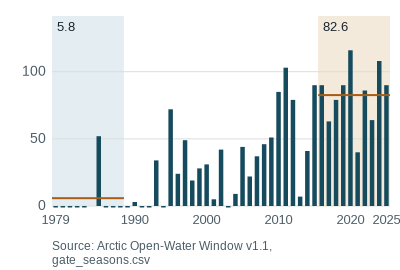
Open days for each full season, 1979 through 2025. Shaded bands mark the early and late decade windows. Lines mark each window mean.
Source: Arctic Open-Water Window v1.1, gate_seasons.csv
| Window | Seasons at zero |
|---|---|
| 1979-1988 | 8 |
| 2016-2025 | 0 |
What the data shows
In 1979-1988, 8 full seasons at Vilkitsky Strait had zero open days. In 2016-2025, that count is 0. A blank open-day count stays blank.
Why it matters
The decade-mean finding gives the length of the open season at Vilkitsky Strait. This finding gives the seasons with no open day at all. Together they describe whether the strait opens, and how long it stays open.
How it was measured
An open day is a day when average sea-ice concentration inside the strait sits below the 15 percent cutoff. Partial seasons are left out. The early window is 1979 through 1988. The late window is 2016 through 2025. A zero season is a full season whose open-day count is zero. A blank value stays blank. Method on the dataset page.
How to read this
Read Vilkitsky Strait's seasons with no open day here, and set the next season beside these two decades when it is in the same table.
Check it yourself
- File
arctic/gate_seasons.csv- Column
open_days_15- Row
gate_id nsr-vilkitsky, partial not True, open_days_15 equal to zero, years 1979-1988 and 2016-2025- API and assistant
- Same key, same data
This API call reads the same cells.
curl "https://api.heimdallresearch.com/v1/arctic/gates/nsr-vilkitsky/seasons" \
  -H "Authorization: Bearer $HEIMDALL_API_KEY"
This assistant prompt asks for the same cells.
MCP https://api.heimdallresearch.com/mcp question: How many full nsr-vilkitsky seasons have open_days_15 equal to zero in 1979-1988 and in 2016-2025?Cite
Heimdall Research (2026). Arctic Open-Water Window (Version 1.1) [Data set]. Zenodo. https://doi.org/10.5281/zenodo.23147722 Concept DOI https://doi.org/10.5281/zenodo.23021977. New version of https://doi.org/10.5281/zenodo.23021978.
@dataset{arctic_open_water_window_1_1,
  author = {{Heimdall Research}},
  title = {Arctic Open-Water Window},
  year = {2026},
  date = {2026-10-10},
  version = {1.1},
  publisher = {Zenodo},
  doi = {10.5281/zenodo.23147722},
  url = {https://doi.org/10.5281/zenodo.23147722},
  license = {CC BY 4.0}
}
Related findings
Arctic Open-Water Window v1.1 NSIDC G02202 v6 and G10016 v4
Not for navigation. Use at your own risk. Provided as is, without warranty of any kind.