
All findings · Arctic Open-Water Window
How did the Barrow gate change between the first and last decade?
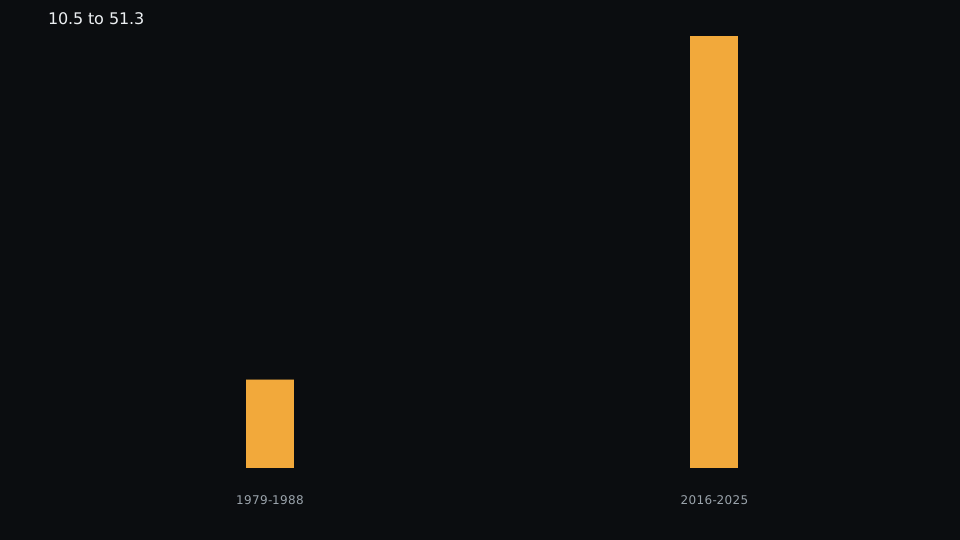
At the Barrow gate, mean open days at the 15 percent cutoff rose from 10.5 days a year in 1979-1988 to 51.3 days in 2016-2025 (difference +40.8 days).
These numbers are Arctic Open-Water Window version 1.0, the published package (3 gates in version 1.0).
Chart
From the table
Reading
What the data shows
For nwp-barrow, mean open_days_15 is 10.5 in 1979-1988 and 51.3 in 2016-2025. The difference is +40.8 days. Among the three published gates, Barrow has the shortest mean open season in 2016-2025.
Context
Why it matters
The Barrow gate sits on Alaska's north coast seasonal open water. Use it to compare that published polygon across decades, not as a local ice chart for a single vessel.
Method
How it was measured
An open day is a day when average sea-ice concentration inside the gate polygon sits below the cutoff named in open_days_15. Partial seasons are left out. The early window is 1979 through 1988. The late window is 2016 through 2025. The difference is the later mean minus the earlier mean. This page is the nwp-barrow rows. Method on the dataset page.
Limits
What this cannot tell you
Polygon average concentration, not ice thickness or a ship route. The 15 percent cutoff is the strictest of the three. Provisional near-real-time days can change. Disclaimer word for word: Not for navigation. Use at your own risk. Provided as is, without warranty of any kind.
Check
Check it yourself
- File
published/gate_seasons.csv- Column
open_days_15- Row
gate_id nwp-barrow, partial not True, years 1979-1988 and 2016-2025- API and assistant
- Same key, same data
This API call reads the same cells.
curl "https://api.heimdallresearch.com/v1/arctic/gates/nwp-barrow/seasons" \
  -H "Authorization: Bearer $HEIMDALL_API_KEY"
This assistant prompt asks for the same cells.
MCP https://api.heimdallresearch.com/mcp question: What is the mean open_days_15 for nwp-barrow in 1979-1988 and in 2016-2025, partial not true?Citation
Dataset citation
Heimdall Research (2026). Arctic Open-Water Window (Version 1.0) [Data set]. Zenodo. https://doi.org/10.5281/zenodo.23021978
- Version
- 1.0
- DOI
- 10.5281/zenodo.23021978
Notes on the wording and the comparison
The sentence on this page is the owner-picked wording. The marked numbers are filled from the check on this page. A later release stays in its own question file until that version is published. The published package is the version named in the citation on this page. Sorting the named file by the named column reaches the same cells. The comparison uses that published file and leaves later releases out. The data dictionary shipped with the package defines the column. A second person can repeat the aggregation from the file alone. Empty cells stay empty. The dataset page states the sensor and the public record behind the file. Rows left out of the aggregation are described in the method section. The download named in the citation is the file to open. The figure changes only when that published file changes. The same cutoff and the same columns are used for every row that enters the figure. A reader who wants the row list can filter the file with the check line on this page. The published package is the version named in the citation on this page. Sorting the named file by the named column reaches the same cells. The comparison uses that published file and leaves later releases out. The data dictionary shipped with the package defines the column. A second person can repeat the aggregation from the file alone. Empty cells stay empty. The dataset page states the sensor and the public record behind the file.
The sentence on this page is the owner-picked wording. The marked numbers are filled from the check on this page. A later release stays in its own question file until that version is published.
The figure is the aggregation named in the check. A different row filter would be a different figure.
A later published version can be set beside this one once that version is the cited release.
Related
Related findings
-
At Vilkitsky Strait, mean open days at the 15 percent ice cutoff rose from 7.9 days a year in 1979-1988 to 82.6 days in 2016-2025 (difference +74.7 days).
Vilkitsky Strait connects the Kara and Laptev seas on the Northern Sea Route.
Breakdown
The published seasons table covers three gates. For Vilkitsky Strait (nsr-vilkitsky), the mean of open_days_15 on full seasons is 7.9 in 1979-1988 and 82.6 in 2016-2025. That is a rise of 74.7 days between those decade windows. An open day here is a day when average sea-ice concentration inside the gate polygon sits below the 15 percent cutoff, the strictest of the three cutoffs in the release.
-
Vilkitsky Strait had 8 seasons with zero open days in 1979-1988 and 0 such seasons in 2016-2025.
If you need both presence and length, read this with the Vilkitsky decade-mean finding.
Breakdown
In 1979-1988, 8 full seasons at nsr-vilkitsky have open_days_15 equal to zero. In 2016-2025, that count is 0. The gate still varies in how long it stays open; what changed here is whether any full season stayed at zero.
-
At Bering Strait, mean open days at the 15 percent cutoff rose from 140.4 days a year in 1979-1988 to 196.5 days in 2016-2025 (difference +56.1 days).
Bering Strait timing matters for communities and seasonal operations on the Pacific-Arctic passage.
Breakdown
For bering-strait, mean open_days_15 on full seasons is 140.4 in 1979-1988 and 196.5 in 2016-2025. The difference is +56.1 days. In the latest decade, Bering Strait still has the longest mean open season of the three published gates.
Not for navigation. Use at your own risk. Provided as is, without warranty of any kind.
Provided as is, without warranty of any kind.
        Source published/gate_seasons.csv e0  1979.
        Source published/gate_seasons.csv e1  1988.
        Source published/gate_seasons.csv l0  2016.
        Source published/gate_seasons.csv l1  2025.
        Source published/gate_seasons.csv early open_days_15 10.5.
        Source published/gate_seasons.csv late open_days_15 51.3.
        Source published/gate_seasons.csv diff open_days_15 40.8.
        Source published/gate_seasons.csv cut open_days_15 15.